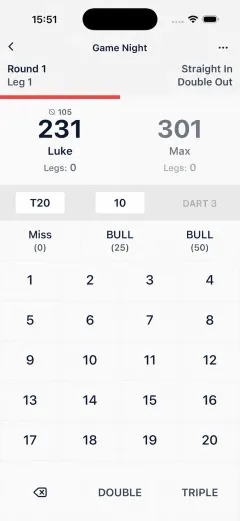
301 Darts Rules - How to Play
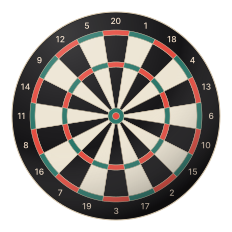
If you’ve played a quick leg in a pub while other people waited for the board, it was probably 301. Each player starts on 301 points, throws 3 darts a turn, and subtracts what they score until one of them lands on exactly zero with a double.
The rules match 501, the standard tournament game, but you start 200 points lower. That makes 301 the usual choice for a short game and a good first game if you’re new to darts. There’s less to add up, and you reach the finishing darts sooner. Move up to 501 when you want a proper scoring phase and room to recover from a poor start.
How a leg plays out
Throw 3 darts, total them, take the total off your score. From 301, a turn of 100 leaves 201.
The scoring phase is shorter than in 501. One takes you from 301 to 121, which is already a finishable number, so you can be thinking about a checkout from your second turn onward. At that stage in a 501 leg you would still be on 321, at least one more big turn from a finish.
For newer players the gap is bigger. At 30 points a turn, you need about 10 turns to score 301 and about 17 to score 501.
There’s no time to settle in, though. Against a decent player, 2 poor turns can cost you the leg.
Scoring
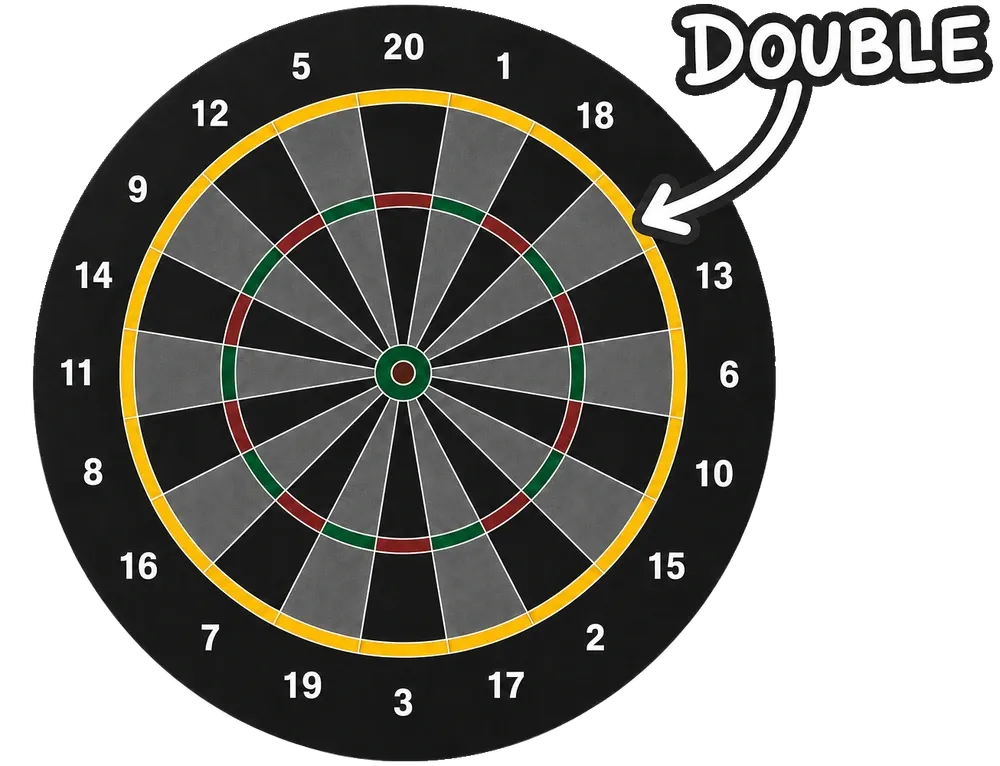
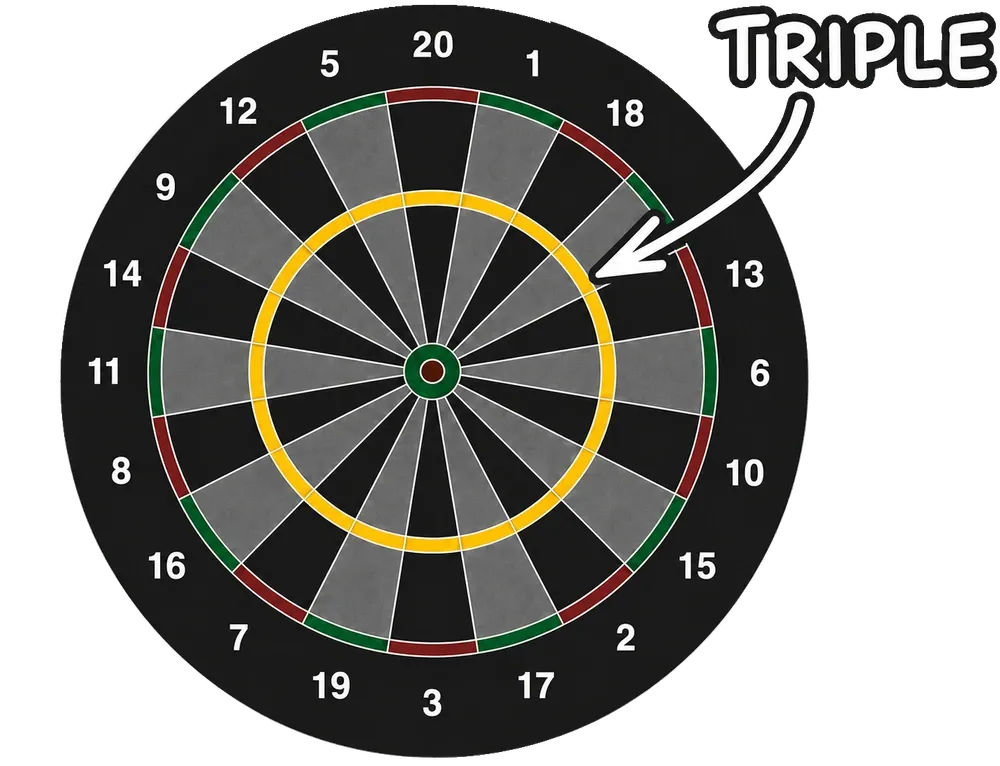
Singles score the number, doubles score twice, triples score 3 times. The outer bull is 25 and the bullseye is 50. The best turn available is 180, with all 3 darts in .
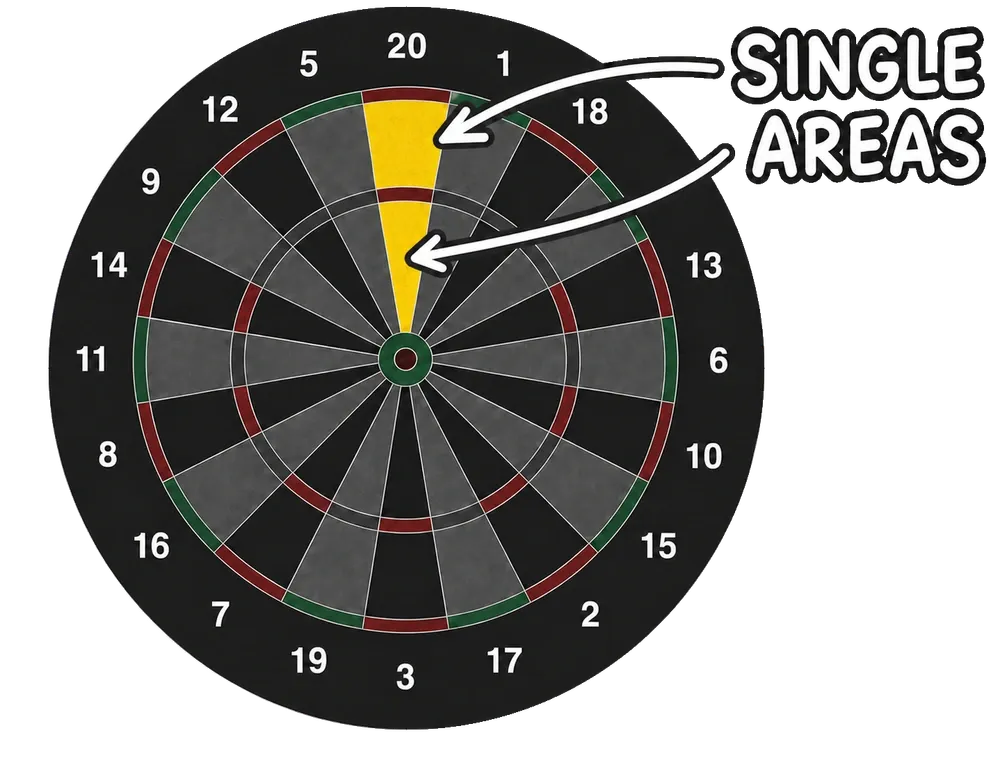
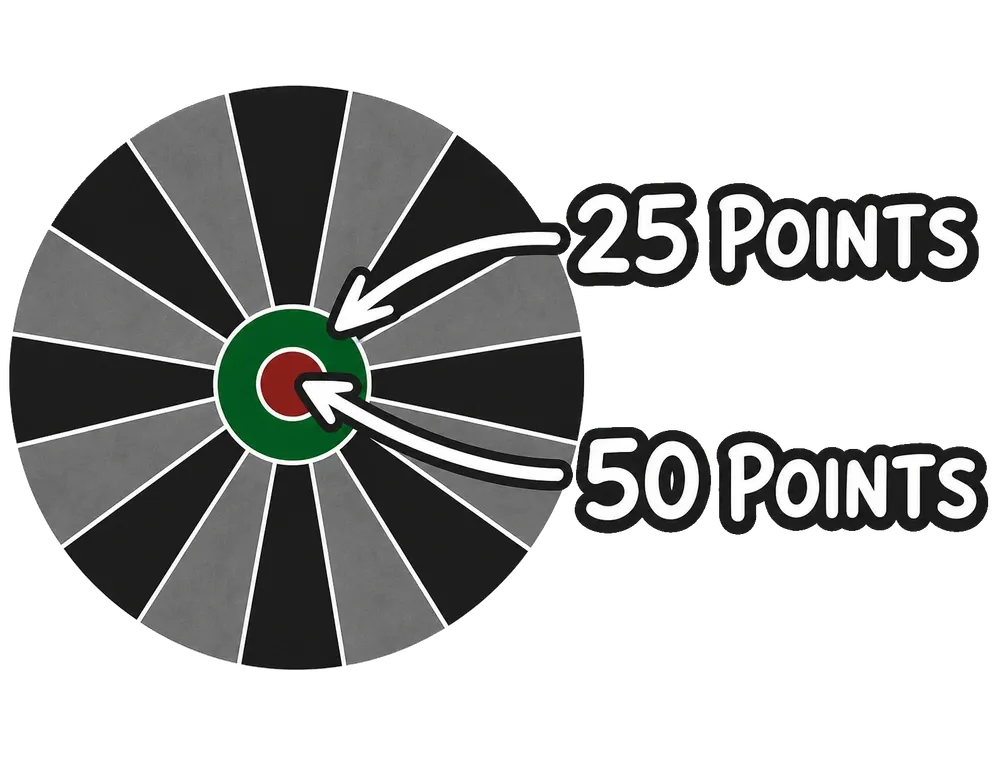
Finishing on a double
The last dart has to be a double and it has to bring you to exactly zero. The bullseye counts, since it is the double of the 25 ring.
Many players aim to leave 40, because a miss into still leaves . The darts checkout calculator gives a route for every score of 170 or less that can be finished in 3 darts.
Casual games sometimes drop the double and play straight-out, where any dart that reaches exactly zero wins. It’s an easy way in if doubles still feel out of reach.
Busts

Score more than you have left or reach zero without a double, and the turn is a bust. Your score goes back to where the turn started. Leaving exactly 1 also busts, because no double is worth 1. After a 180 you’re on 121. Throw , and you’re on 1, so the turn busts and you’re back on 121.
Double-in 301
Some pubs and leagues play 301 double-in. Your score doesn’t move until you hit a double, and darts thrown before it score nothing. The double itself counts, and so does every dart after it.
Hit with your first dart and you’re on 261, with 2 darts left to score. Miss the doubles with all 3 darts and you stay on 301 for another turn.
Double-in is a house rule, so agree on it before the first dart. The X01 guide covers the other ways to start a game.
The 6 dart leg
301 can be won in 6 darts. A 180 leaves 121, and 121 finishes as , , . There are other routes: 167 and 134 also add up to 301.
Double-in doesn’t rule it out. Open with , , for 160, then check out 141 with , , .
That’s 3 darts fewer than a perfect leg of 501.
Stats tracked in DartsOn
At the end of each leg, DartsOn shows these stats for each player:
| Stat | What it shows |
|---|---|
| 3-Dart Avg (Average) | Your average points per 3 darts in the leg. A busted turn scores 0 and counts as 3 darts. |
| First 9 Avg | Your 3-dart avg over the first 9 darts of the leg. |
| Darts Thrown | Darts thrown in the leg. |
| Checkout % | Turns that started on 170 or less, or 180 or less with straight-out or master-out, and how many of them ended the leg, for example 33% (1/3). |
| High Score | Your highest turn in the leg. |
| Total Turns | Turns taken in the leg. |
| 0, 1-59, 60-99, 100-139, 140-179, and 180 Turns | How many of your turns scored in each range. |
| Heat map | Where each player's darts landed. Tap it for a full-screen view of every landing. Shown when darts are scored with the camera or entered by tapping the board. |
At the end of the game, you also see these stats across every leg, with your Best High Score, the legs and sets each player won, and your 3-dart avg in each leg.