X01 Rules - How to Play
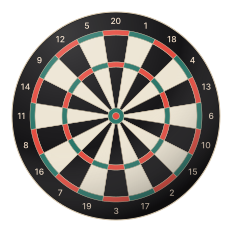
X01 is the family of darts games where every player starts on a set score and counts down to exactly zero. Replace the X with 3, 5, 7, or 10 and you get the starting score: 301, 501, 701, or 1001.
Also known as: 01.
Two of these games have their own guides:
- 501 is the standard game, played at professional tournaments and in league matches.
- 301 is the quick one, popular in pubs and with beginners.
This guide covers the rules every X01 game shares, then everything you can change: the starting score, how players start and finish, match length, teams, and handicaps.
The basics of X01
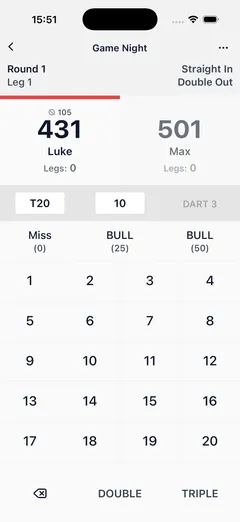
Each player throws 3 darts per turn, adds up the score, and subtracts it from their remaining total. Start a turn on 701, score 85, and you have 616 left.
A leg is one complete game from the starting score to zero. The first player to reach exactly zero wins it. Most games use double-out, so the winning dart must hit a double.
How scoring works
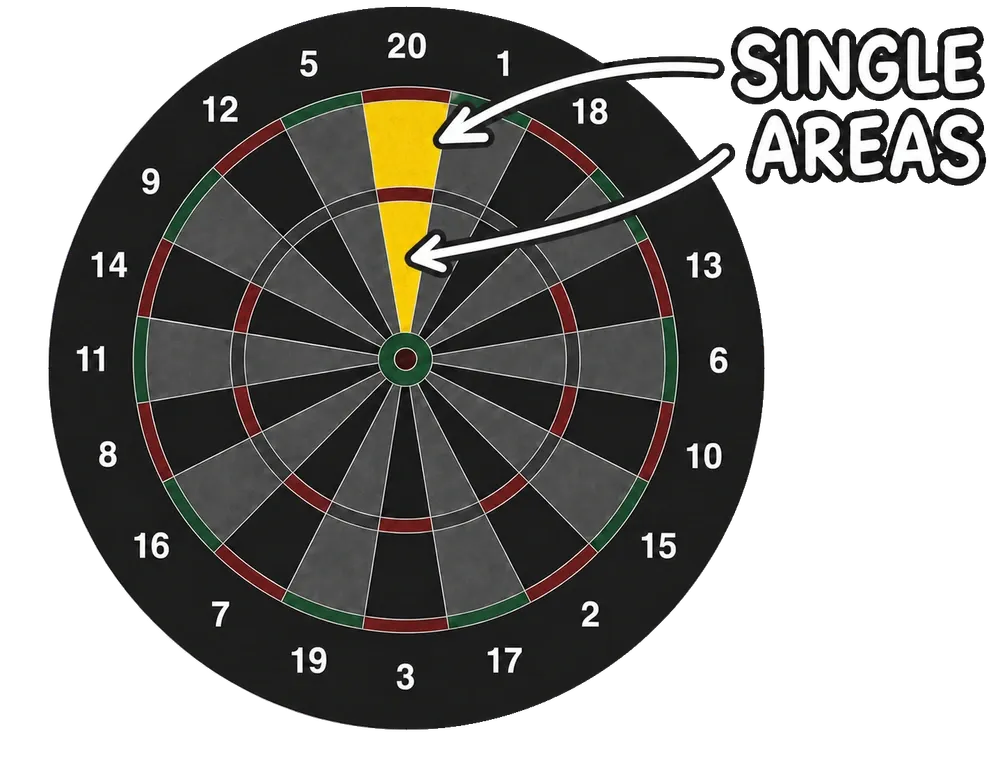
Every X01 game scores the same way, whatever the starting score. What a dart is worth depends on where it lands:
| Where the dart lands | Points | Example |
|---|---|---|
| Either single area | The number | = 19 points |
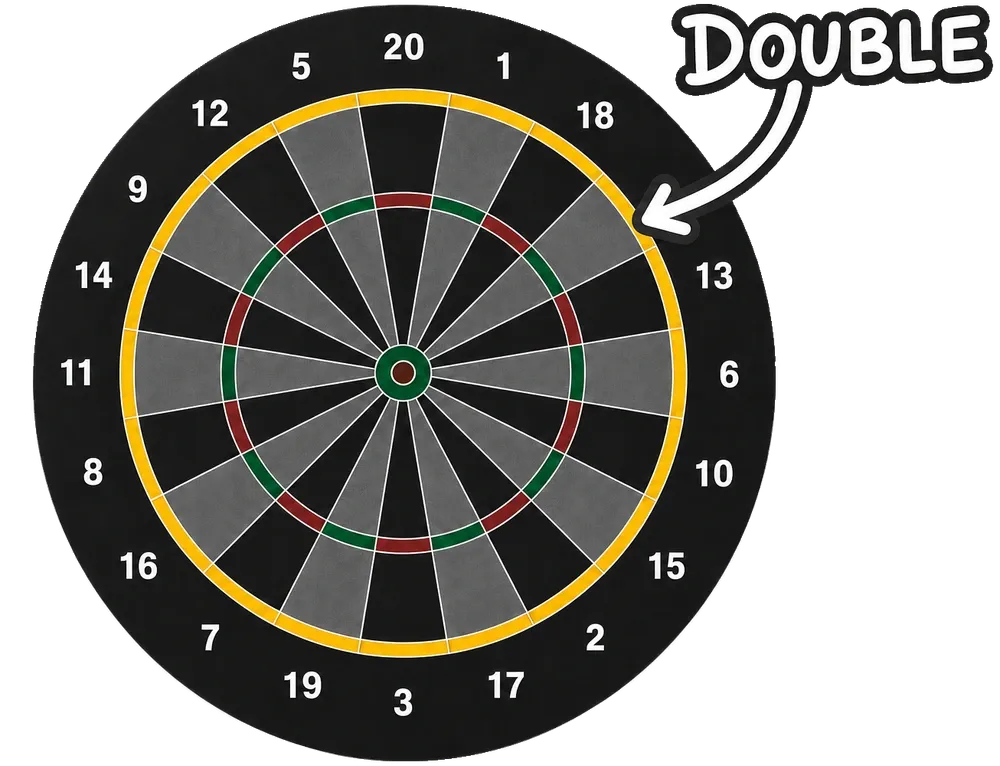
| Double ring, the thin outer band | 2 × the number | = 38 points |
| Triple ring, the thin inner band | 3 × the number | = 57 points |
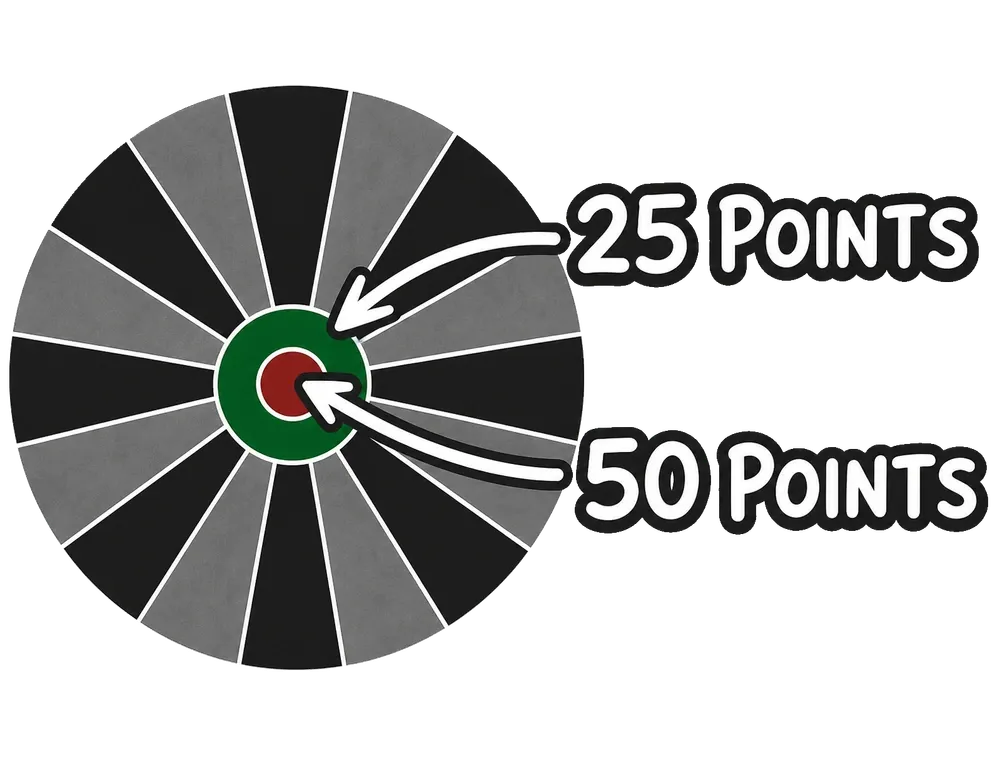
| Outer bull | 25 | = 25 points |
| Bullseye | 50 | = 50 points |
| Outside the double ring | 0 | A miss |
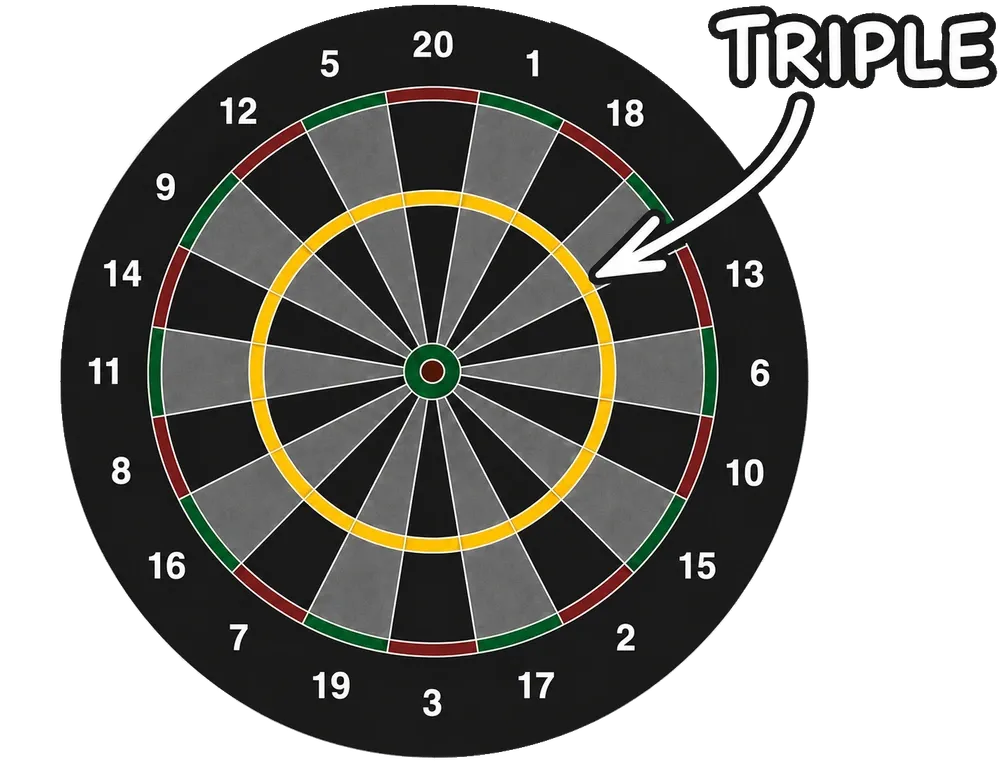
No turn can score more than 180, which needs all 3 darts in .
X01 game settings
Every X01 game comes down to 4 choices: the starting score, the starting rule, the ending rule, and how many legs or sets win the match. These are the combinations you’re most likely to come across:
| Format | Where you’ll see it |
|---|---|
| 501, straight-in, double-out | The standard game in professional and league darts |
| 301, straight-in, double-out | Quick games in pubs and at home |
| 301, double-in, double-out | A traditional pub and league rule |
| 501, double-in, double-out | A harder format used at some major events |
| 701, straight-in, master-out | Soft-tip tournaments on electronic boards |
| Any score, straight-out | Beginners and casual games |
| 701 or 1001 | Pairs and team matches |
Starting score
The starting score decides how long a leg lasts. With a double finish, the fewest darts that can win a leg are 6 from 301, 9 from 501, 12 from 701, and 17 from 1001.
Any other number works too, and the rules stay the same. A low score such as 121 skips straight to finishing practice. The 121 Checkout drill builds a whole game around it.
Starting the game
Most games are straight-in, so every dart counts from the first turn. Double-in and master-in make each player earn their first points.
| Starting rule | How it works |
|---|---|
| Straight-in | Every dart scores from the start |
| Double-in | Scoring starts with a double or the bullseye. Darts before it score nothing, and the double counts |
| Master-in | Scoring starts with a double, triple, or the bullseye. Darts before it score nothing, and that dart counts |
Under double-in, a first turn of , , scores 100. The single doesn’t count, the double starts your scoring, and the triple counts as normal. Miss the doubles with all 3 darts and your score stays where it is until a later turn.
Once a player has started scoring, the starting rule no longer applies to them.
Finishing the game
| Ending rule | Winning dart | if you | Max checkout |
|---|---|---|---|
| Straight-out | Any dart | Go below zero | 180 |
| Double-out | A double or the bullseye | Go below zero, leave 1, or reach zero on a single or triple | 170 |
| Master-out | A double, triple, or the bullseye | Go below zero, leave 1, or reach zero on a single | 180 |
The max checkout is the highest score you can finish in one turn of 3 darts.
Double-out is the standard. Straight-out is the easiest way to finish and a good choice for beginners. Master-out sits in between. Triples finish too, but you still can’t leave 1, because no double or triple is worth 1.

A bust ends the turn. Your score goes back to what it was at the start of the turn, none of that turn’s darts count, and play passes to the next player.
The darts checkout calculator finds a double-out route for every score of 170 or less that can be finished in 3 darts.
Legs, sets and round limits
A match is usually first to, or best of, a number of legs. Longer matches group legs into sets. The 501 guide explains how they work.
Some players and scoring apps also set a round limit so a leg can’t drag on. If nobody checks out in time, the lowest remaining score wins the leg. Agree beforehand how to settle a tie.
Teams and 3 or more players
Any number of players can join. Everyone throws in a fixed order and works down their own score, and the first to reach zero wins the leg. In a bigger group, you can keep playing after that to decide the other places.
In pairs and team games, partners share one score and take turns throwing for it. Teams sometimes start from 701 or 1001 so everyone gets enough turns.
Handicaps
A handicap gives players of different standards a close game. The simplest one is a different starting score for each player, such as 501 for the stronger player and 301 for the newer one.
You can also change the rules for one player. Let a beginner finish straight-out while their opponent still needs a double, or ask the stronger player to double in.
Scoring averages
Averages compare how much players score, whatever the starting score.
- 3-dart avg is the average points scored per 3 darts. It’s the figure most players quote.
- Points per dart (PPD) is the average score for each dart thrown. A 3-dart avg of 60 equals 20 PPD.
- Points per round (PPR) is another name for the 3-dart avg.
- First 9 avg is your 3-dart avg over the first 9 darts of a leg. First 12 and First 15 avg work the same way over 12 and 15 darts.
A busted turn scores 0 and counts as 3 darts, even if the bust came on the first dart. The turn that checks out counts only the darts thrown.
Stats tracked in DartsOn
At the end of each leg, DartsOn shows these stats for each player:
| Stat | What it shows |
|---|---|
| 3-Dart Avg (Average) | Your average points per 3 darts in the leg. A busted turn scores 0 and counts as 3 darts. |
| First 9 Avg | Your 3-dart avg over the first 9 darts of the leg. |
| Darts Thrown | Darts thrown in the leg. |
| Checkout % | Turns that started on 170 or less, or 180 or less with straight-out or master-out, and how many of them ended the leg, for example 33% (1/3). |
| High Score | Your highest turn in the leg. |
| Total Turns | Turns taken in the leg. |
| 0, 1-59, 60-99, 100-139, 140-179, and 180 Turns | How many of your turns scored in each range. |
| Heat map | Where each player's darts landed. Tap it for a full-screen view of every landing. Shown when darts are scored with the camera or entered by tapping the board. |
At the end of the game, you also see these stats across every leg, with your Best High Score, the legs and sets each player won, and your 3-dart avg in each leg.