
How to play darts: Rules for beginners
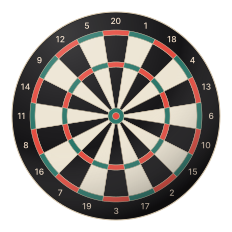
Players take turns throwing 3 darts at a round board, and where each dart lands decides its score. That part of the rules is the same in almost every darts game. What changes is what you aim at and how you win.
The most popular game is 501. Both players start on 501 and take away what they score each turn. The first to reach exactly zero wins, and the last dart has to land in a .
What you need
- A dartboard. A traditional bristle board takes darts. An electronic board takes darts and adds up the score for you.
- 3 darts per player. Two players can share a set if they swap after each turn.
- A throwing line. The line you stand behind is called the oche. Tape works fine.
- Something to keep score with. A chalkboard, a notepad, or a scoring app.
Hang a steel-tip board so the centre of the bullseye is 173 cm / 5 ft 8 in above the floor, and put the oche 237 cm / 7 ft 9¼ in from the front of the board. Soft-tip boards use the same height, with the oche usually 244 cm / 8 ft away. The dartboard setup guide has diagrams for both.
How the dartboard scores
The board is split into 20 numbered sections. The number printed around the edge is what that section scores, and each section has 3 scoring areas:
- The large areas are singles. They score the number shown.
- The narrow outer ring is the double ring. It scores twice the number, so scores 40.
- The narrow inner ring is the triple ring. It scores three times the number, so scores 60. A triple is also called a treble.
In the middle, the outer bull scores 25 and the bullseye scores 50. The bullseye counts as a double when you need one to finish.
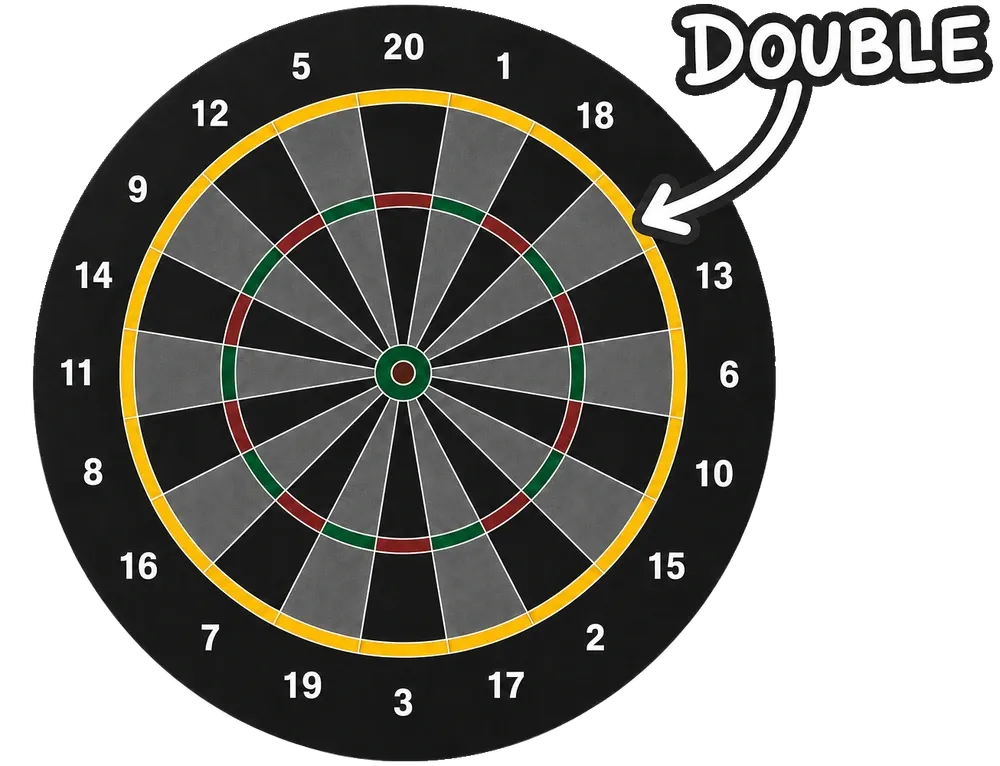
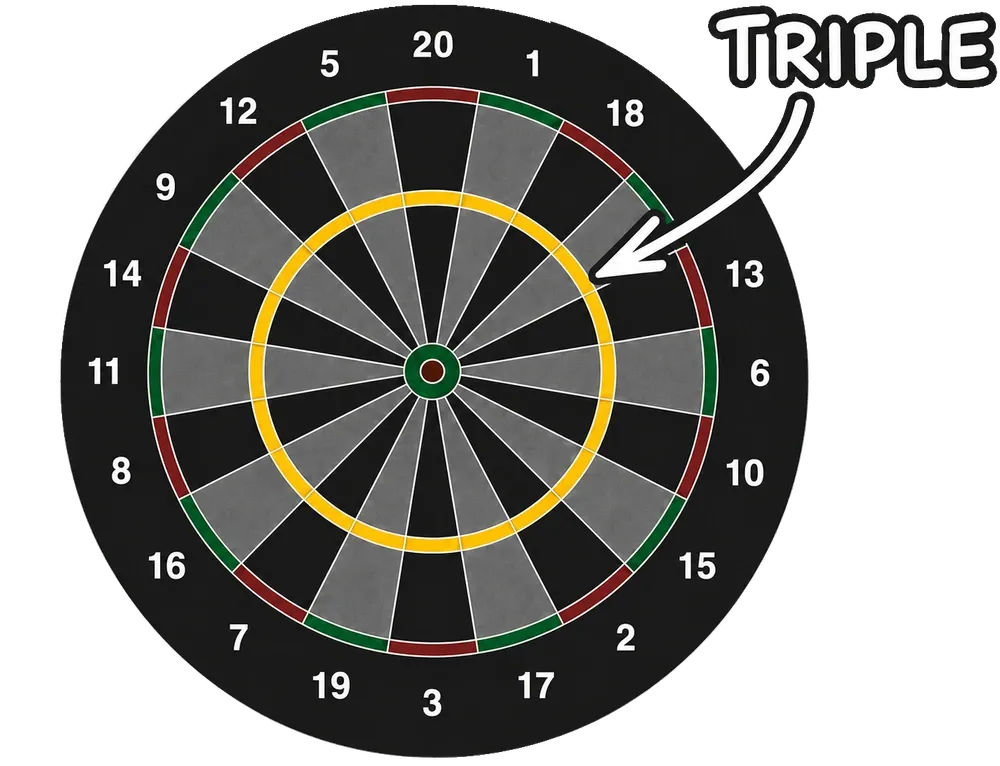
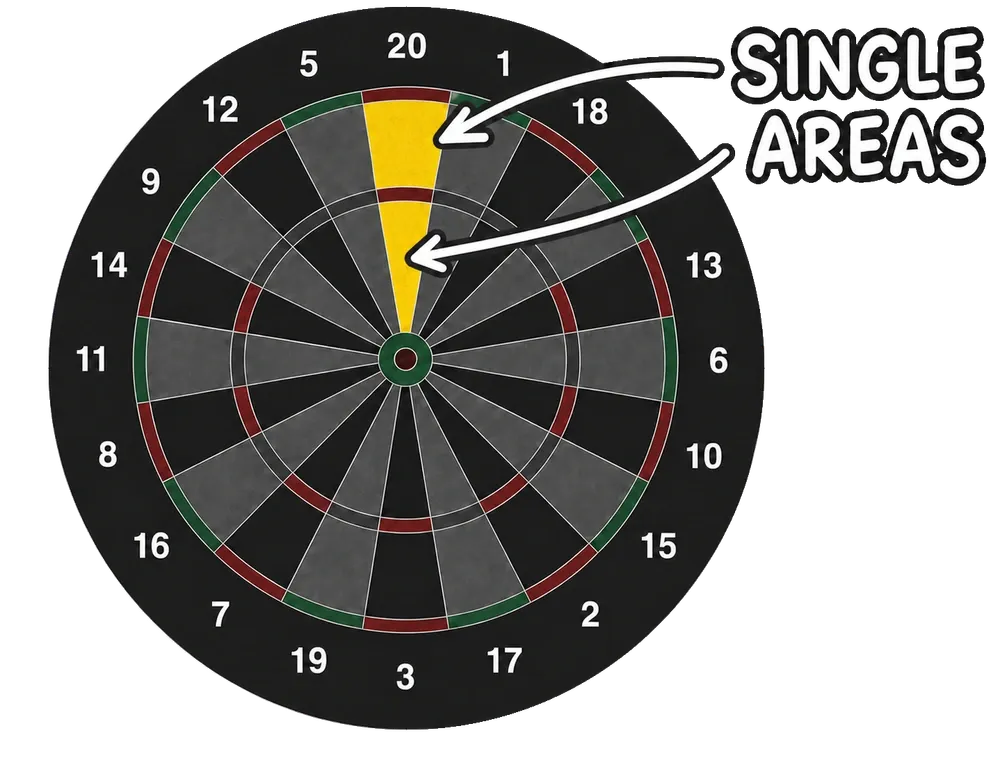
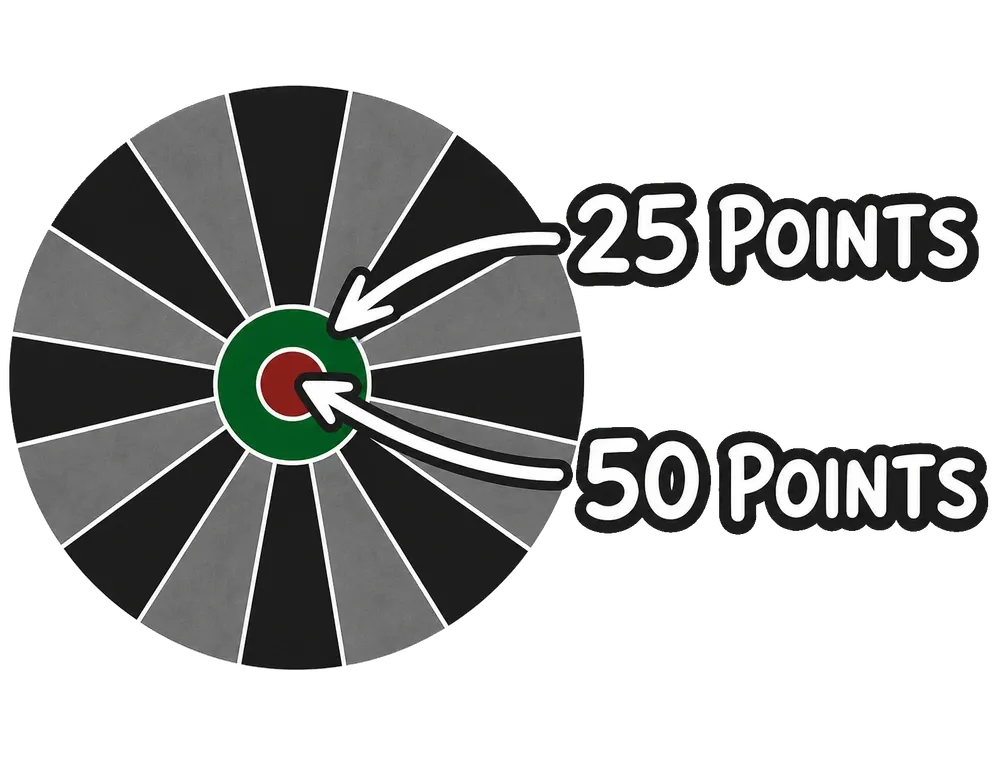
A dart outside the double ring scores nothing. is the highest-scoring target on the board, worth 10 more than the bullseye. The best possible turn is all 3 darts in , a score of 180.
The numbers don’t run in order. The 20 at the top sits between 5 and 1, so a dart that drifts off the can score very little. Accuracy pays off far more than throwing hard.
Basic darts rules
These rules apply to most darts games.
- Throw 3 darts per turn. Then add up your score, collect your darts, and step aside for the next player. Don’t touch a dart in the board before you’ve thrown all 3, as that ends your turn. A turn is also called a visit.
- Throw for the bull to decide who starts. Each player throws one dart at the bullseye, and whoever lands closest goes first. In a match, players then take turns starting each game.
- Keep your feet behind the oche. You can lean over the line as far as you like, but don’t stand on it or step over it while you throw.
- Only darts in the board score. A dart that bounces off, or falls out before you collect it, scores nothing, and you can’t throw it again. Electronic boards count whatever they register, even if the dart drops out later.
- A dart scores where its point is. If the point goes into the , it scores 60, even if the dart leans over another number. A point right against a wire scores the segment on the side it went in.
How to play 501
501 is the game you see on TV and the one most leagues play.
- Each player starts on 501.
- Throw 3 darts, add them up, and take the total away from your score. A turn of , , and scores 85, so 501 becomes 416.
- Keep going until someone reaches exactly zero. The last dart must land in a double or the bullseye.
With 40 left, wins. With 50 left, the bullseye wins. Finishing like this is called a checkout. If you finish with your first or second dart, you don’t throw the rest.
If you score too much, the turn is a bust. That happens when you go below zero, leave exactly 1, or reach zero without a double. The turn ends right there, and your score goes back to what it was when the turn started. On 32, a busts, and you are still on 32 next turn.
One game from 501 down to zero is called a leg. Matches are played over several legs. In a best of 5 match, the first to win 3 legs takes the match. Longer matches group legs into sets.
For the full rules, see how to play 501. The checkout calculator shows how to finish from any score.
How to play Cricket
Cricket is a game of tactics that uses only 15 to 20 and the bull.
- Hit a number 3 times to close it. A single gives 1 mark, a double gives 2 marks, and a triple gives 3 marks. The outer bull gives 1 mark and the bullseye gives 2 marks.
- Once you’ve closed a number, every extra hit on it scores points, as long as your opponent hasn’t closed it too. When both players have closed a number, nobody can score on it.
- To win, close every number and have at least as many points as your opponent.
The Cricket rules cover scoring examples and the common variants.
Which game to play first
501 is a hard place to start. A leg takes a lot of darts, and finishing on a double is tricky when you are still learning to hit the board. Try these games first, in this order:
- 301 . The same scoring as 501, starting 200 points lower. Any dart that takes you to exactly zero wins, so you don’t need a double. Some players call this single-out. Once 301 feels easy, move on to 501 with a double finish.
- Around the Clock. Hit every number from 1 to 20 in order, then the bull. It is the fastest way to learn where the numbers are.
- Cricket. You only aim at 15 to 20 and the bull, and every turn you choose between scoring points and closing numbers. The basics are in the section above.
- Half It. Each round has a new target, such as 15, any double, or the bull. Miss it with all 3 darts and your score is cut in half.
- Count Up. Every dart scores its full value, and the highest total after a set number of rounds wins. It works well with children or mixed groups.
Heard a term you don’t know? The darts glossary explains legs, checkouts, busts, and the rest.


