
X01 darts stats explained, from 3-dart avg to checkout %
What each X01 number in DartsOn means and how it's counted, from 3-dart avg and first 9 avg to checkout %, high scores, records and Cricket MPR.
DartsOn shows the same X01 numbers on the Statistics tab and on each game’s summary. This page explains what each one measures and how DartsOn counts it, so you know what a change in your numbers means.
Only your own darts count. Bot turns never enter your averages.
An example leg
The sections below use this 501 leg with Double Out:
| Turn | Darts | Scored | Left |
|---|---|---|---|
| 1 | T20, 20, 20 | 100 | 401 |
| 2 | T20, T20, 20 | 140 | 261 |
| 3 | T20, 20, 20 | 100 | 161 |
| 4 | T20, 20, 20 | 100 | 61 |
| 5 | T20, bust | 0 | 61 |
| 6 | T15, D8 | 61 | 0 |
In turn 5, T20 leaves 1, which can’t be finished on a double, so the turn busts and you stay on 61.
3-dart avg
Your average score per 3 darts, and the main measure of X01 form. DartsOn adds up the points you scored, divides by the darts you threw and multiplies by 3. See 3-dart avg in the glossary.
Two rules decide what counts:
- A bust scores 0 and counts as 3 darts, even when it came on your first or second dart.
- A checkout turn counts only the darts you threw. Finishing with your first dart adds 1 dart, not 3.
The example leg scores 501 points. Its darts are 4 full turns, 3 for the bust and 2 for the checkout, so 17 in all. 501 ÷ 17 × 3 = 88.41.
The Statistics tab shows it as 3-Dart Avg. A game’s summary calls it Average.
For a sense of scale, DartsOn’s bots range from a 15.5 avg at Bot Level 1 to 105.1 at Bot Level 16. See your record against bots.
1-dart avg
Your average score per dart, which is the 3-dart avg divided by 3. A 60 average is 20 per dart. It appears as the 1-Dart Avg line on the X01 trend chart. See PPD in the glossary.
First 9 avg
The 3-dart avg of your first 3 turns in each leg. Those are usually pure scoring turns, before you’re close enough to aim at a finish, so the first 9 avg shows your scoring without your finishing. See first 9 avg in the glossary.
The example leg’s first 9 darts scored 340, and 340 ÷ 9 × 3 = 113.33. A bust in your first 3 turns counts here too, as 0 points from 3 darts.
The Stats table also has First 12 Avg and First 15 Avg, your first 4 and 5 turns of each leg.
Checkout %
How often you finish when you have the chance. DartsOn counts it by turn:
- An attempt is a turn you start on a score you could finish. With Double Out, that’s 170 or less. With Straight Out or Master Out, it’s 180 or less.
- A hit is a turn that wins the leg.
In the example leg, you start turn 4 on 161 and turns 5 and 6 on 61. That’s 3 attempts and 1 hit, so 33.3%.
Every turn you start inside the range counts, even when you can’t finish in 3 darts. A turn started on 169 is an attempt, though 169 is a bogey number.
Some scorers count each dart thrown at a winning double instead, which gives a different number. Compare like with like. See checkout percentage in the glossary.
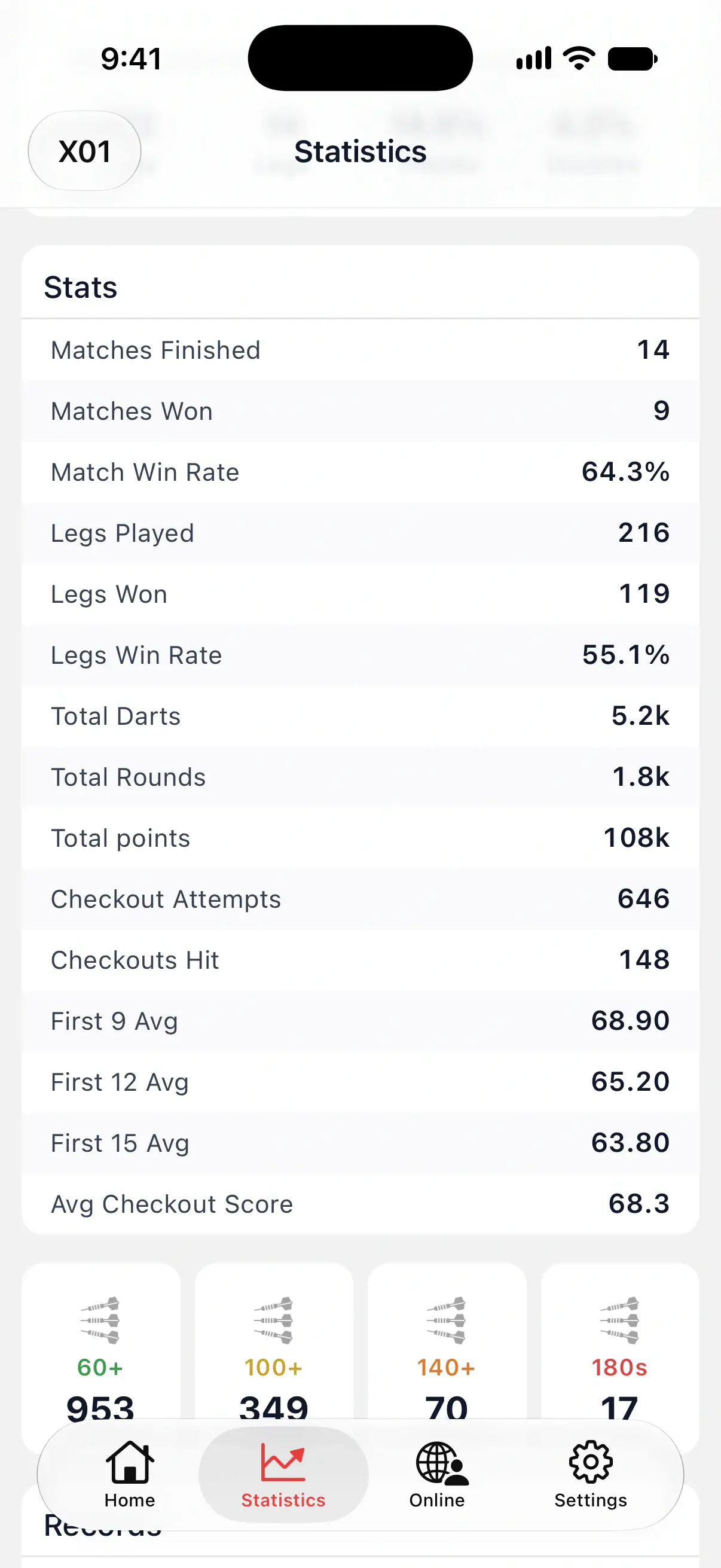
On a game’s summary, Checkout % also shows the count, such as 33% (1/3). The Stats table on the Statistics tab lists Checkout Attempts and Checkouts Hit, plus Avg Checkout Score, the average score you finished from.
To raise your checkout %, practise your finishes. The checkout suggestions show a route for every finishable score.
Darts, legs and turns
- Total Darts counts darts the same way as the average, so a busted turn adds 3. The example leg adds 17.
- Legs Played counts every leg you threw in, finished or not. Legs Won and Legs Win Rate count the legs you won.
- Total Rounds counts your turns.
- Total points adds up your scores, with busted turns as 0.
A game’s summary counts darts and busts the same way.

60+, 100+, 140+ and 180s
These count your high-scoring turns. A busted turn counts as 0, whatever its darts scored.
On the Statistics tab, the tiles add up from the top. A 180 counts in 60+, 100+, 140+ and 180s. The example leg adds 5 to 60+, 4 to 100+ and 1 to 140+. Tap a tile to see how many of those turns you average per leg.
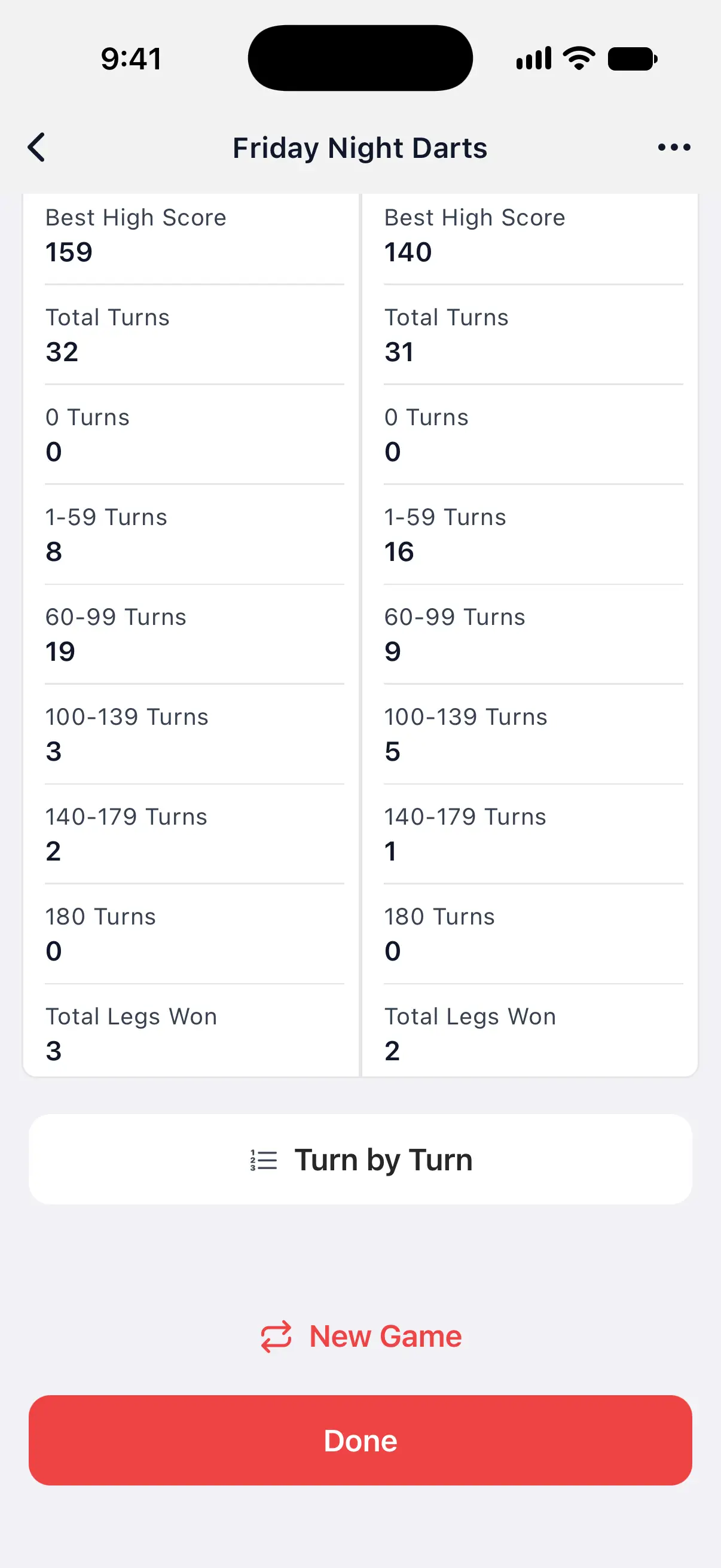
A game’s summary splits your turns into bands that don’t overlap: 0 Turns, 1-59 Turns, 60-99 Turns, 100-139 Turns, 140-179 Turns and 180 Turns, with Total Turns above them. The example leg has 1 turn of 0, 1 of 60 to 99, 3 of 100 to 139 and 1 of 140 to 179.
Records
The Records card on the Statistics tab holds 3 personal bests:
- Best Leg is the fewest darts you’ve taken to win a leg. Busted turns count as 3 darts here too, so the example leg is a 17 dart leg. A 9 dart leg is the perfect 501.
- Highest Checkout is the biggest score you’ve finished from, with the darts that did it, such as 121 (T20, 25, D18).
- High Score is your best single turn. 180 is the maximum.
A game’s summary shows High Score for the leg, and Best High Score on the Game Stats tab.
Wins and losses
Wins & losses counts finished games where you played someone, a bot included. Your win rate is your wins divided by your wins plus losses.
Games you played alone are listed as 1-Player and leave your win rate alone. So does a game you haven’t finished.
The Stats table repeats these as Matches Finished, Matches Won and Match Win Rate, next to the leg counts.
Cricket MPR
MPR means marks per round, the marks you score per 3 darts. DartsOn divides your marks by the darts you threw and multiplies by 3. A single is 1 mark, a double 2 and a treble 3. See MPR in the glossary.
Every dart counts toward the darts thrown, misses included. A leg won on the first or second dart of a turn counts only the darts you threw. On the Statistics tab, a hit on a number you’ve already closed still counts its marks.
The Cricket stats add a few more numbers:
- Closing efficiency is the average round in which you close a number. Lower is better.
- Best MPR round is your best single turn as an MPR. 3 trebles make 9.
- Trebles / Doubles / Singles shows how your hits on Cricket numbers split between the rings.
See the Cricket rules for how marks and closing work.
Questions and answers
How does DartsOn calculate the 3-dart average?
DartsOn divides the points you scored by the darts you threw and multiplies by 3. A busted turn counts as 0 points from 3 darts, and a checkout turn counts only the darts you threw.
Does a bust lower my average in DartsOn?
Yes. A bust scores 0 and counts as 3 darts, even if it came on your first dart, so it costs you a full turn in your average.
How does DartsOn count checkout percentage?
By turn. Every turn you start on a score you could finish is one attempt, and the turn that wins the leg is a hit. With Double Out, that's any turn you start on 170 or less.
What's the difference between the 3-dart avg and the first 9 avg?
The 3-dart avg covers every dart of every leg. The first 9 avg covers only your first 3 turns of each leg, before you start aiming at a finish, so it shows your scoring on its own.
Related
- Track your darts statistics in DartsOn Pick a player, game mode and time period on the Statistics tab, filter by rules, and see your averages, checkouts, high scores and records.
- Review a finished darts game in DartsOn Find past games on Home, read their summaries leg by leg, continue an unfinished game and share any local game or online match as a PDF, text or CSV.
- How checkout suggestions work in DartsOn See checkout and setup suggestions in DartsOn. Pick your preferred double, customize routes for each ending rule, or turn suggestions off.